
Contents
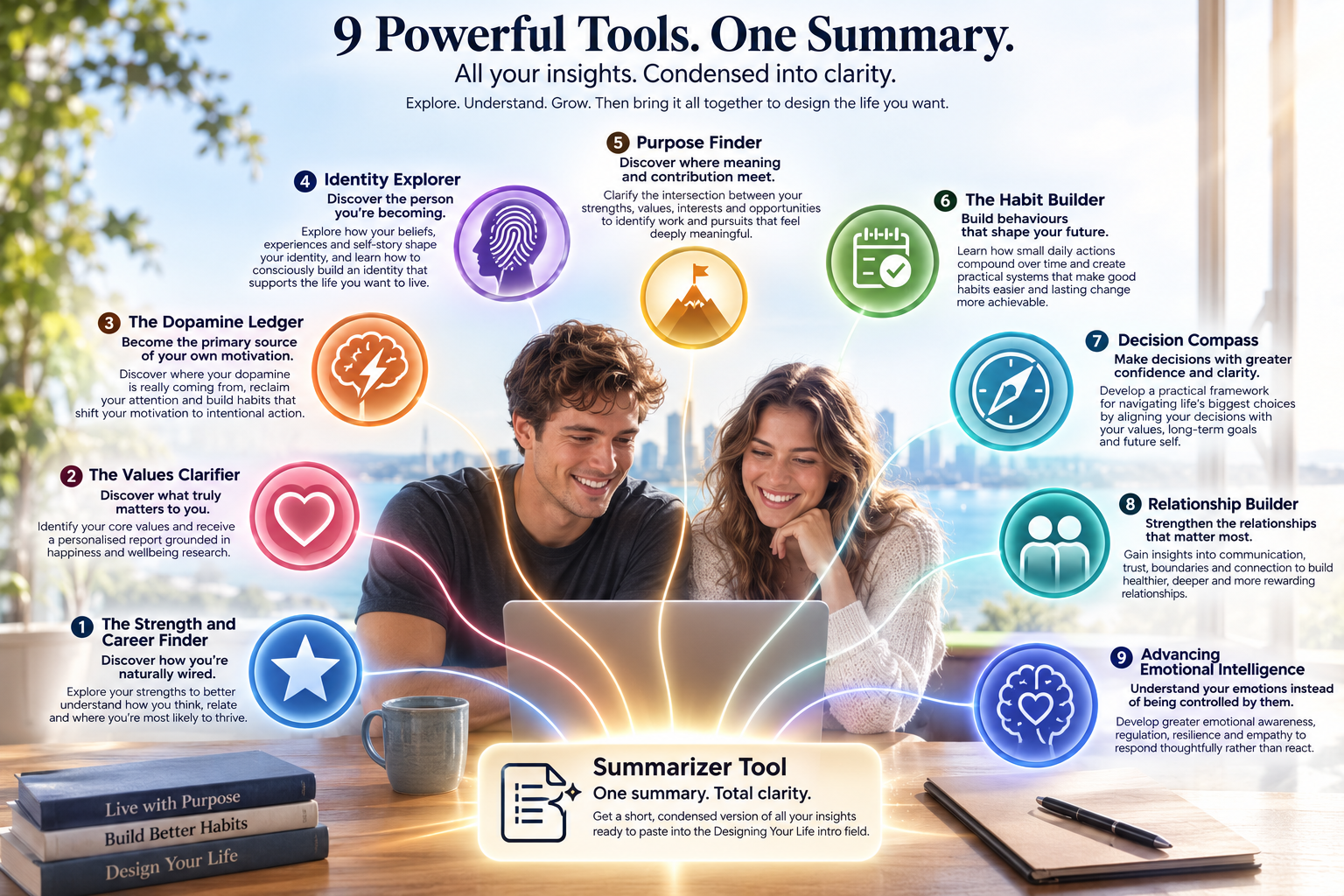
1. The Strength and Career Finder
Discover how you're naturally wired.
Explore your cognitive, emotional, social, motivational, and execution strengths to better understand how you think, solve problems, relate to others, and where you're most likely to thrive.
2. The Values Clarifier
Discover what truly matters to you.
Identify your core values, reflect on how they shape your decisions, relationships, and direction in life, and receive a personalised report grounded in happiness and wellbeing research.
3. The Dopamine Ledger
Become the primary source of your own motivation.
Discover where your dopamine is really coming from, reclaim your attention in a world designed to distract you, and build habits that shift your motivation from external stimulation to intentional action.
4. Identity Explorer
Discover the person you're becoming.
Explore how your beliefs, experiences, and self-story shape your identity, and learn how to consciously build an identity that supports the life you want to live.
5. Purpose Finder
Discover where meaning and contribution meet.
Clarify the intersection between your strengths, values, interests, and opportunities to identify work and pursuits that feel deeply meaningful.
6. The Habit Builder
Build behaviours that shape your future.
Learn how small daily actions compound over time and create practical systems that make good habits easier and lasting change more achievable.
7. Decision Compass
Make decisions with greater confidence and clarity.
Develop a practical framework for navigating life's biggest choices by aligning your decisions with your values, long-term goals, and future self.
8. Relationship Builder
Strengthen the relationships that matter most.
Gain insights into communication, trust, boundaries, and connection to build healthier, deeper, and more rewarding relationships.
9. Advancing Emotional Intelligence
Understand your emotions instead of being controlled by them.
Develop greater emotional awareness, regulation, resilience, and empathy to respond thoughtfully rather than react automatically.
10. Report Summarizer
Paste in your reports from any tools you've completed. Leave any blank you haven't done. Click Summarize to get a short, condensed version ready to paste into the Designing Your Life intro field.
11. Designing Your Life
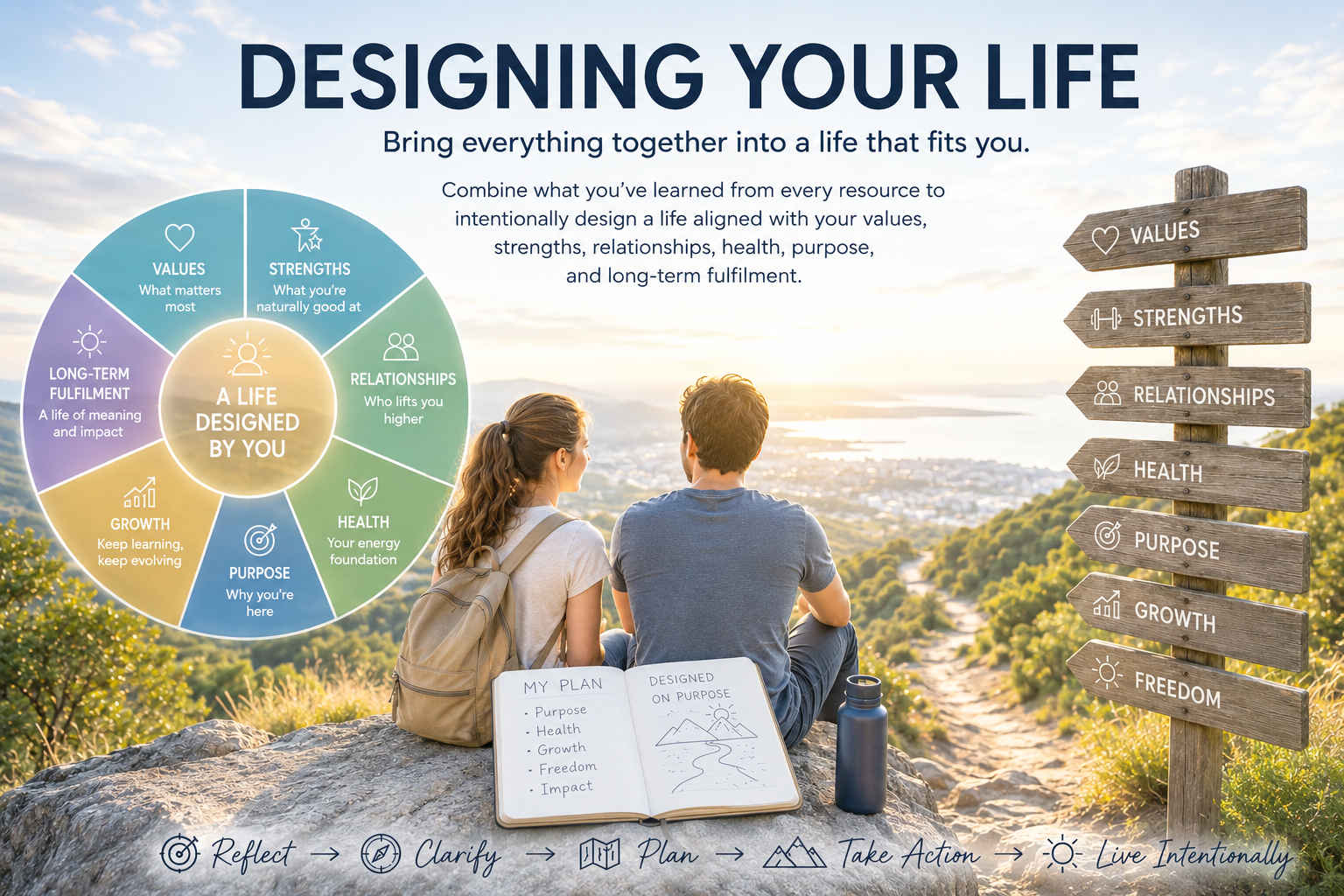
Bring everything together into a life that fits you.
Combine what you've learned from every resource to intentionally design a life aligned with your values, strengths, relationships, health, purpose, and long-term fulfilment.
12. Complete Reference List - All Ten Tools
Each tool below is listed with its sources in three formats: an APA 7th edition reference list, a Harvard-style bibliography, and a version grouped by topic.
1. The Strength and Career Finder
Most career advice starts in the wrong place — with job titles, industries, or whatever's trending, rather than with the actual person trying to build a life. The Strength & Career Finder starts where it should: with you. Across 180 statements spanning six domains — how you think, how you connect with others, how you execute, how you handle emotion, what actually drives you, and the environments where you thrive — this tool builds a genuinely detailed picture of how you're wired. Not a four-letter personality type or a vague "you're a natural leader" platitude, but a real, specific map of your cognitive patterns, social instincts, discipline under pressure, emotional depth, true motivators, and the exact conditions your best work actually needs.
Then it does the part most assessments skip: it turns that map into direction. Your personalized report names your dominant archetype, identifies your strongest and weakest sub-domains, and surfaces the blind spots sitting quietly underneath your strengths — the kind you can't always see from the inside.
Most importantly, it delivers your top five career matches, each with real, specific reasons drawn directly from your own answers — not generic titles that could apply to anyone, but paths that actually fit the person your results describe. This isn't about finding a job. It's about finding the shape of work your particular mind, temperament, and values were already built for.

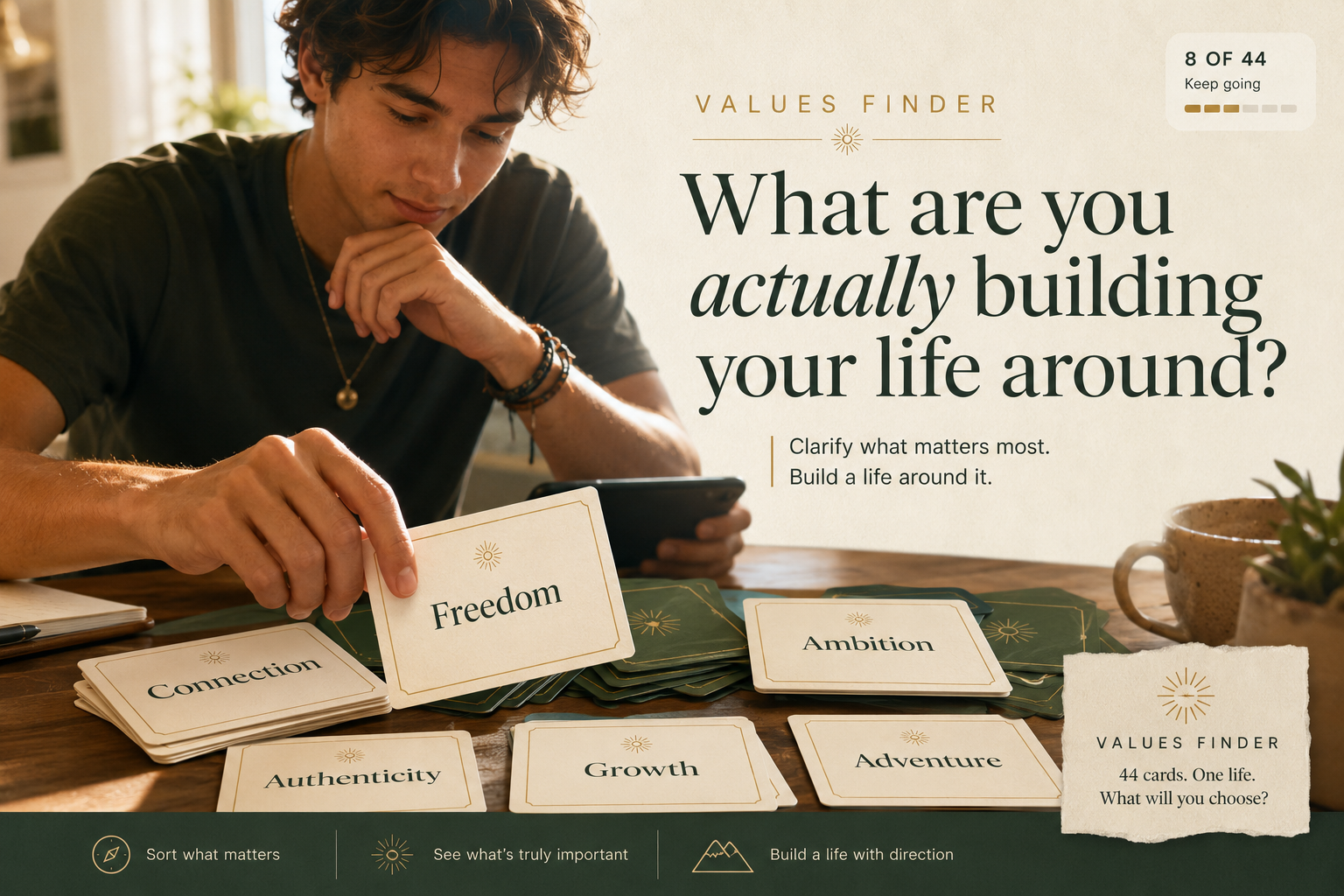
2. The Values Clarifier
Most values quizzes hand you a list and call it self-knowledge — a tidy label that sounds right but rarely changes anything. The Values Clarifier is built for something deeper: real clarity, the kind that comes not from what you affirm, but from what you're willing to let go of. It exists to surface the handful of values that actually drive your best decisions, separating what genuinely matters to you from what simply sounds good.
What makes this tool different is the research underneath it. Rather than treating all values as equally worthwhile, it draws on genuine happiness research — the work of Arthur Brooks and Tim Kasser on what actually sustains lasting fulfillment versus what only feels like it should — so the values you land on can be measured against real evidence, not assumption.
Most valuably, it looks beneath the values themselves, to the motivation driving them — because the same value can be a genuine source of fulfillment or a quiet, fear-driven substitute for it, depending on why it's held. This isn't about judgment. It's about walking away with real insight into whether the things you say matter to you are actually built to carry the life you're trying to create.
3. The Dopamine Ledger
You pick up your phone to check one thing, and forty minutes disappear into a feed you didn't choose. Then you feel flatter than when you started — not better. That's not a willpower problem. It's a design problem. Every app is competing for the same currency: your dopamine, engineered to deliver instant, on-demand hits that quietly borrow against tomorrow's motivation. Do that enough, and your baseline drops — the things that actually build a meaningful life start to feel like too much effort, not because you've changed, but because your dopamine has been redirected without your noticing.
The Dopamine Ledger exists to give that power back. It's built on real research — the pleasure-pain balance described by Dr. Anna Lembke, and the evolutionary science showing dopamine was never meant to reward passive consumption, but genuine pursuit and effort toward a goal. Where most tools stop at "spend less time on your phone," this one goes further: it looks at whether your dopamine-driven energy is actually flowing toward the goals and growth you say you want, or quietly leaking into attention traps engineered to capture it.
At the centre of it is a simple, almost sneaky practice - by making discipline, dopamine generating - by giving small gifts to your future self, so the good feeling that follows is one you generated yourself, not one an app handed you. The result is a personalized report that shows you exactly where your attention is going, how goal-centric your life currently is, and what it would take to become your own primary source of motivation again — not by deleting your apps, but by understanding dopamine well enough to make it work for you instead of against you.

4. Identity Explorer
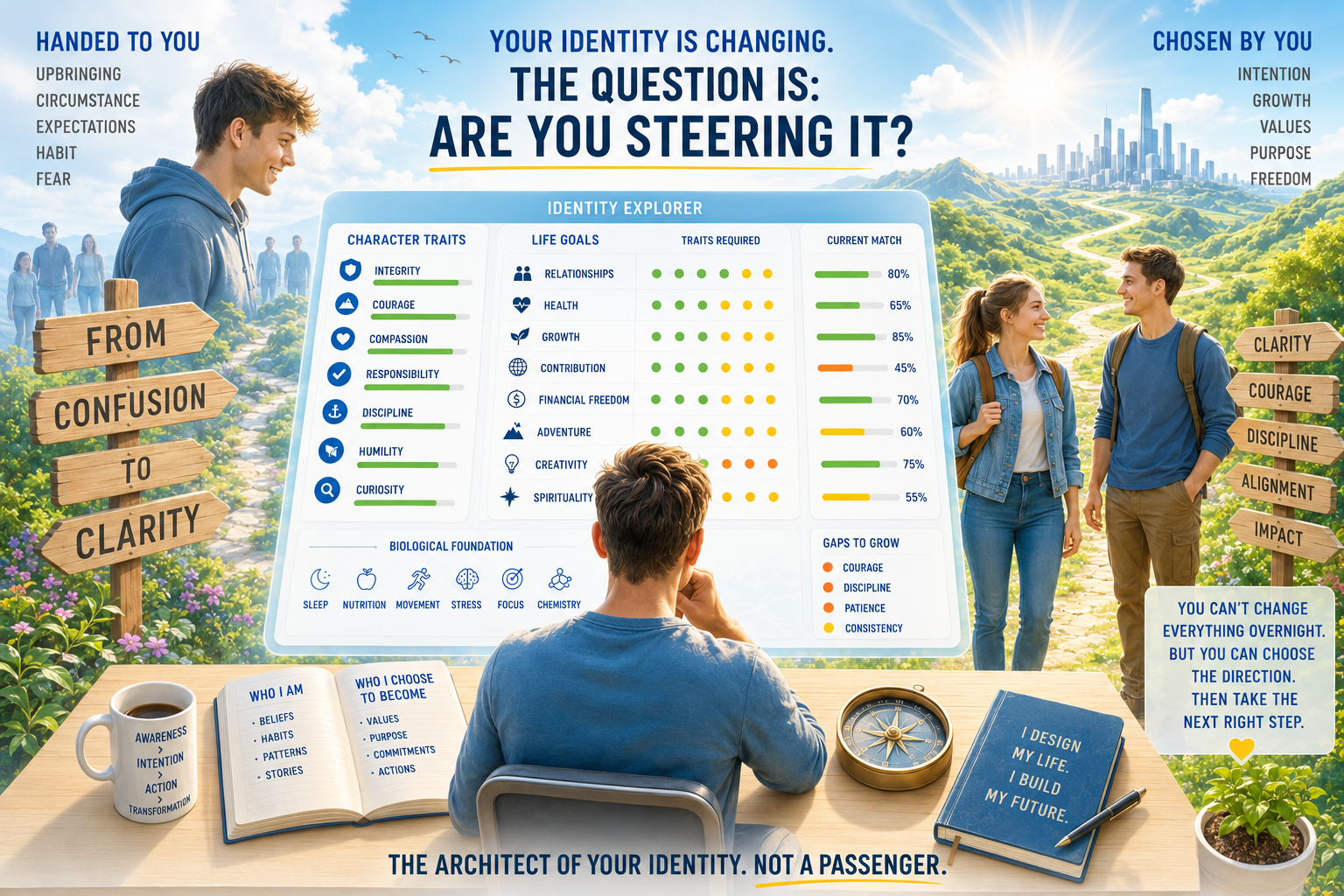
You're not the same person you were five years ago — and you won't be the same person five years from now, whether you choose that or not. The question isn't whether your identity changes. It's whether you're the one steering it.
Most people carry an identity that was handed to them — shaped by upbringing, circumstance, and habit, rarely chosen with intention. The Identity Explorer helps you see what you're actually working with: the character traits underneath your personality, the values driving your choices, and the goals you're reaching for — often without realizing which parts of who you are might already be standing in the way.
It starts by mapping your character across the traits that hold everything else up — integrity, courage, compassion, responsibility, and more — then asks you to name real goals across the areas of life that matter most to you. Here's where it gets genuinely useful: the tool identifies exactly which traits each goal demands, and quietly checks them against who you actually are right now. Where there's a gap, it tells you — gently, specifically, and without judgment. It also looks at the biological foundation underneath it all, because identity change isn't just a mindset shift; it runs on the same chemistry that governs motivation and follow-through.
The result isn't a personality label. It's a clear, honest map of who you need to become to get where you're actually trying to go — and a starting point for becoming the architect of your own identity, rather than a passenger in it.
5. The Purpose Finder
Most people search for purpose the way they'd search for a lost set of keys — frantically, in one place, hoping to stumble on it. But purpose doesn't hide in a single spot. It leaves traces everywhere: in the moments you lost track of time, the problems that quietly bother you, the compliments that have followed you your whole life, the thing you'd still do even if no one noticed.
The Purpose Finder is built to help you find those traces and see where they overlap.
Across nine areas — the moments you've felt most alive, your natural strengths, your core values, your genuine curiosities, who you want to help, where you see yourself in ten years, what energizes rather than drains you, what your hardest experiences taught you, and the idea you can't quite shake — you'll build a real, detailed picture of your own patterns. Add in how you actually want to live (leading or supporting, stability or adventure, local or global), and a moment to reflect before you're done, and you get something most purpose exercises skip entirely: evidence, not guesswork.
Your personalized report — generated instantly, right there on the page — reads all of it together, the way a psychologist, career coach, and purpose researcher would: naming your top five purpose themes, drafting three possible purpose statements, and pointing to specific careers, causes, and communities that fit what you've actually described. It doesn't stop at insight — it gives you a real 90-day plan to start living it.
One thing worth knowing going in: this isn't meant to hand you a single, permanent answer carved in stone. It's your current purpose direction — a clear, evidence-based hypothesis, built from your own life, that you get to test, live into, and refine as you grow. That's not a smaller thing than "finding your purpose." It's a truer one.

6. The Habit Builder
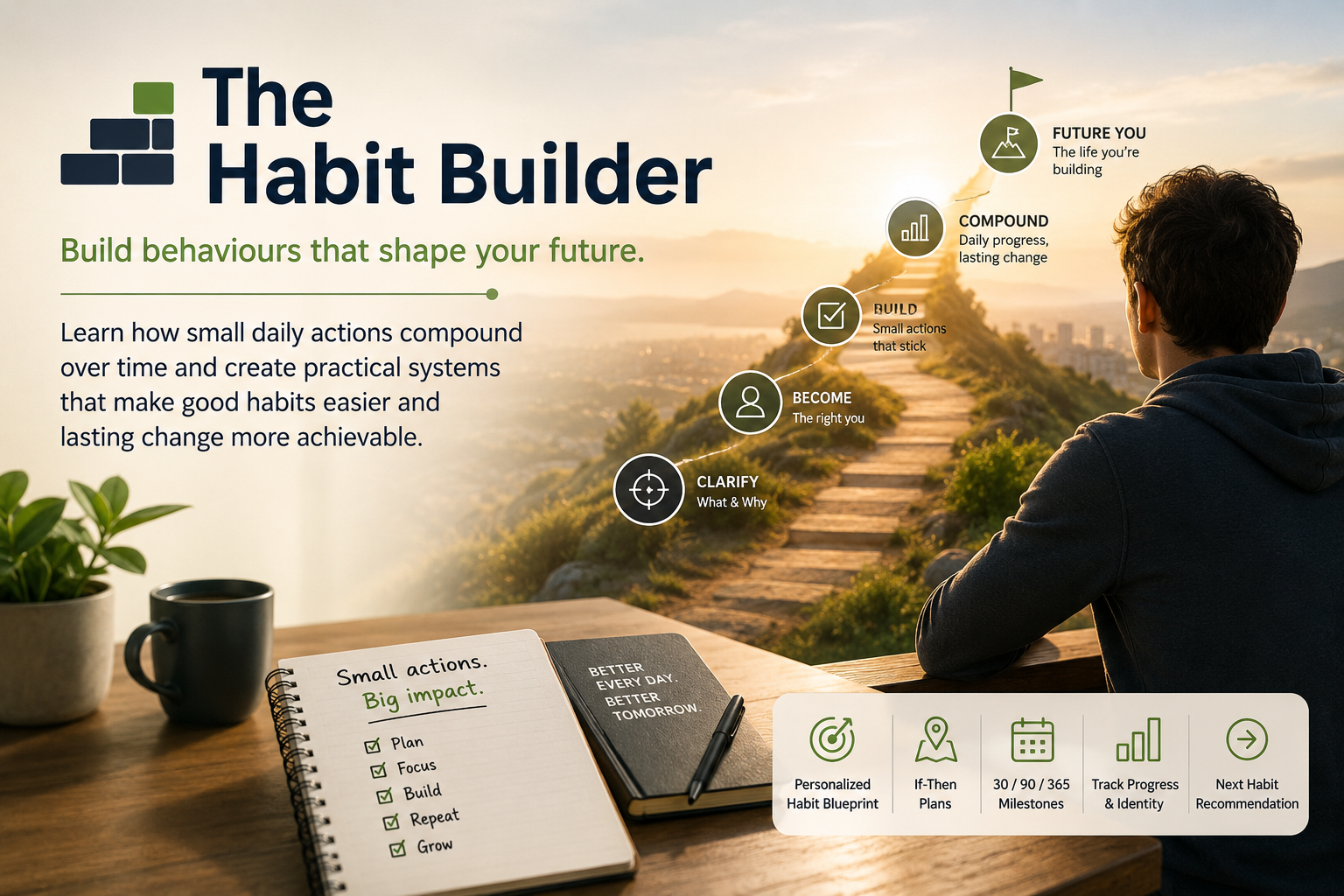
You already know that small actions, repeated, change everything. The problem was never knowing that — it was knowing how, specifically, for your life.
Most habit advice stops at "just be consistent," as if consistency were a personality trait rather than a system you can actually design. The Habit Builder treats it as exactly that: a system. It starts by asking what you're actually trying to achieve, and why it matters enough to act on — then, crucially, asks who you'd have to become to get there. Habits aren't just things you do. They're evidence, collected daily, of the person you're becoming. Miss that piece, and even a well-built habit tends to quietly fall apart the moment motivation dips.
From there, the tool gets specific in a way most habit trackers never bother to. It helps you turn a vague intention into an exact, five-minute-or-less action, anchored to something you already do without thinking. It walks you through the "five whys" until you hit the real reason underneath the surface-level goal. It has you name the obstacles most likely to knock you off course — not in the abstract, but as concrete "if this happens, I'll do this instead" plans, built before you need them, not scrambled together in the moment you're tempted to quit.
What comes out the other end isn't a generic checklist. It's your own personalized Habit Blueprint — a report that shows you exactly why this habit matters to you, what in your environment is working for or against you, the identity it's quietly reinforcing every time you follow through, and realistic milestones at 30, 90, and 365 days, built on the real research (closer to 66 days than the popular "21 days" myth). It even points you toward the next habit worth building once this one runs on autopilot.
This isn't about willpower. It's about building a system good enough that willpower barely has to show up.
7. Decision Compass
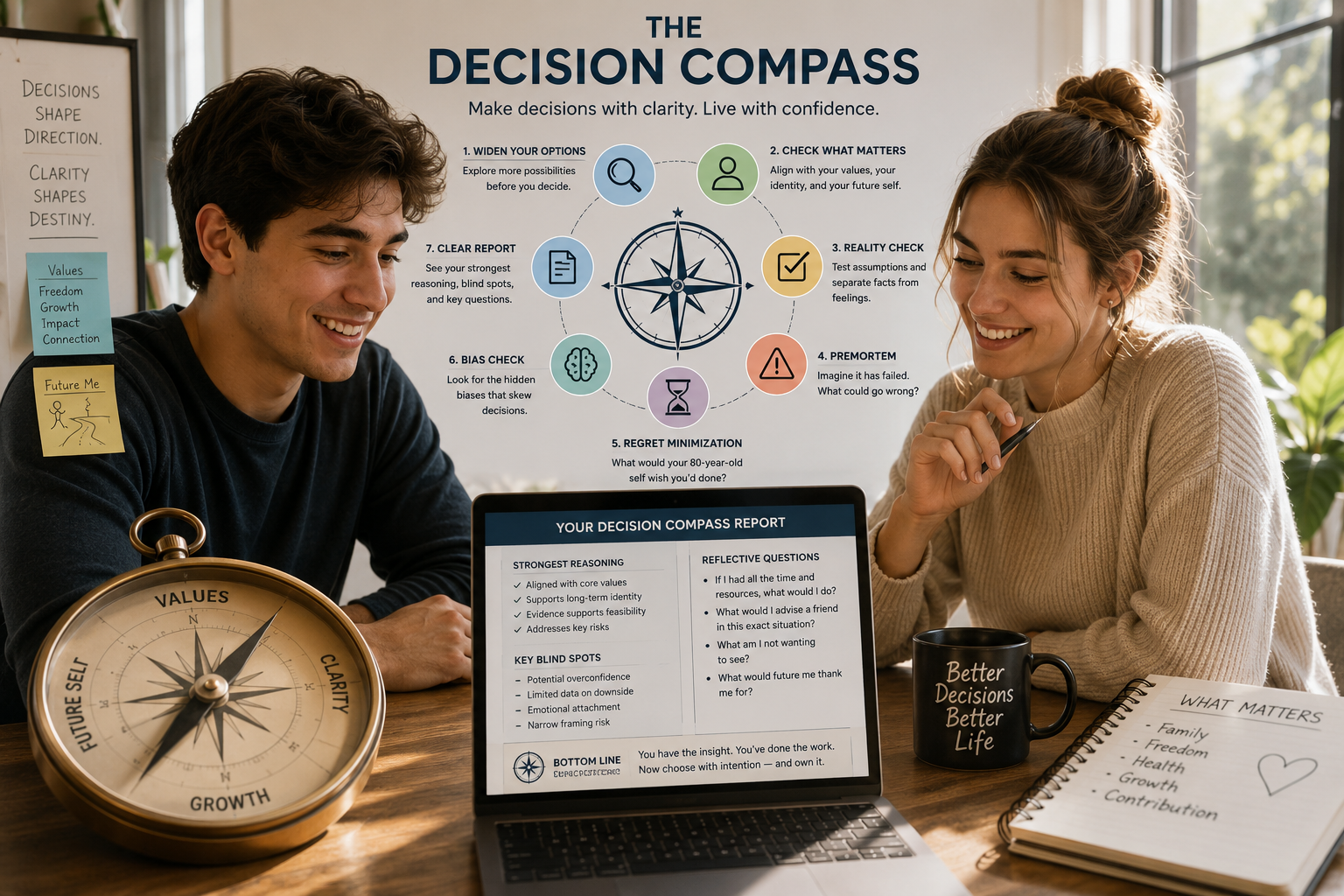
The Decision Compass
Most decision-making advice boils down to "trust your gut" or "make a pros and cons list" — neither of which accounts for the specific ways human reasoning quietly goes wrong. The Decision Compass is built differently. It walks you through a real, research-backed process: widening your options before narrowing them, reality-testing the assumptions you didn't know you were making, and deliberately stepping outside the emotional pull of the moment to see your choice more clearly.
Along the way, it checks your decision against what actually matters — your stated values, the identity you're building, and a vivid picture of your future self looking back on this exact moment. It runs a premortem, imagining the decision has already failed, to surface risks that forward-looking optimism tends to miss. It applies Jeff Bezos' regret-minimization framework, asking what your 80-year-old self would wish you'd done. And it runs an honest bias check — narrow framing, confirmation bias, overconfidence — the specific, well-documented ways good people make bad calls.
The result isn't a verdict telling you what to choose. It's a clear, organized report that names your strongest reasoning, your blind spots, and the reflective questions most likely to bring you to a decision you can stand behind — with confidence that's actually earned, not just felt.
8. Relationship Builder
Most relationship advice assumes the goal is finding the right person, or fixing one specific conflict. The Relationship Builder starts from a different premise, backed by 40 years of research on what actually separates thriving relationships from struggling ones: healthy relationships aren't found — they're built, through the same behaviours practiced again and again. It works for any relationship that matters to you — romantic partner, friend, family member, or colleague — because the underlying patterns are the same.
Across ten areas, you'll examine the foundation of the relationship, how you communicate and respond to each other's small bids for connection, what actually happens when conflict arises, how much trust and emotional safety genuinely exists, whether boundaries are respected, and whether the relationship feels reciprocal or quietly one-sided. You'll name the specific behaviours — not personality labels — that build trust and the ones that erode it, and look honestly at whether this relationship is helping you grow or slowly costing you something.
What you get back isn't a verdict on the other person — the tool never diagnoses or labels anyone, yours or theirs. It's a clear, research-grounded reflection of your own patterns, the strengths already working in your favour, and a set of realistic actions fully within your control. Because in the end, you can't change another person. You can only change how you show up — and that's usually enough to change everything else.

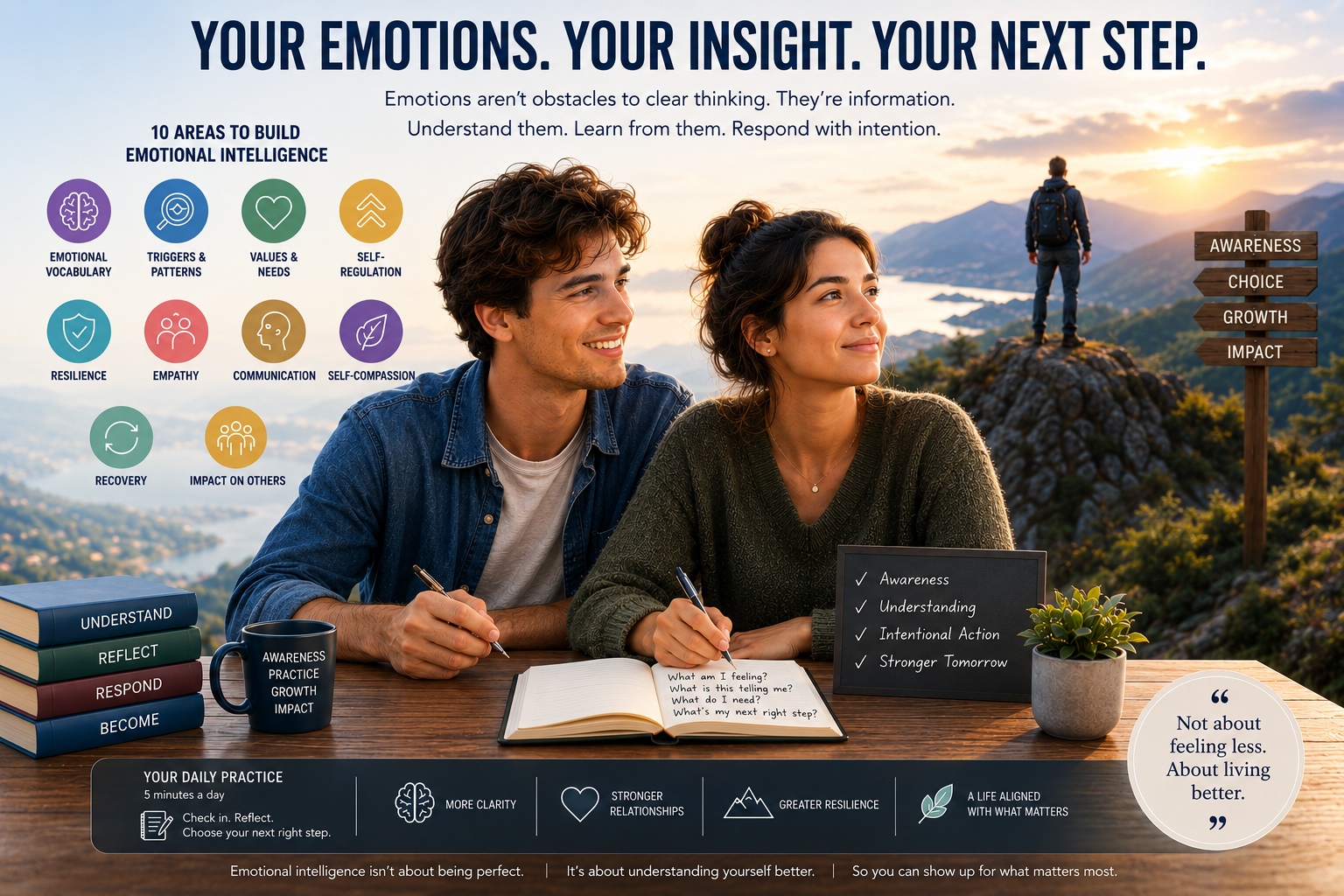
9. Advancing Emotional Intelligence
Most people were never taught what to actually do with a strong emotion — so it either gets suppressed until it leaks out sideways, or it takes the wheel entirely. Advancing Emotional Intelligence starts from a different premise: emotions aren't obstacles to clear thinking. They're information. The goal was never to feel less — it's to understand what a feeling is actually telling you, so you can respond with intention instead of reacting on autopilot.
Across ten areas, you'll build real emotional vocabulary beyond "fine" and "angry," trace your triggers back to their patterns, and uncover what your strongest reactions reveal about the values and needs sitting underneath them. You'll examine a phenomenon most people experience but rarely name — feeling guilty for being angry, or anxious about being anxious — and look honestly at whether your current coping strategies actually help, or just postpone the problem. From there, it moves outward: how your emotions affect the people around you, how quickly you recover from setbacks, and whether you extend yourself the same compassion you'd offer a friend.
What comes back isn't a personality label or a verdict on your character. It's a clear map of your emotional patterns — grounded in real research, not vague self-help language — along with specific, practical strategies suited to your actual triggers, and one concrete daily practice to start building the skill you need most. Because emotional intelligence isn't a trait you either have or don't. It's a skill, built the same way any other skill is: through awareness, practice, and honest attention over time.
10. Report Summarizer
Paste in your reports from any tools you've completed. Leave any blank you haven't done. Click Summarize to get a short, condensed version ready to paste into the Designing Your Life intro field.
11. Designing Your Life
Every other tool on this site helps you understand one piece of yourself — your values, your strengths, your habits, your relationships, your emotional patterns. Designing Your Life is where all of that finally becomes one coherent picture. Built on the Stanford d.school framework of the same name, it treats your life the way a good designer treats any complex problem: not as something to be discovered by accident, but built deliberately, tested, and refined over time.
Across twelve stages, you'll take stock of where you genuinely stand.
Twelve stages that walk through the full life-design process.
A rating of where you currently stand across health, work, relationships, and purpose.
Identification of the moments that make time disappear for you.
Identification of beliefs quietly holding you back.
Three distinct five-year visions of your future, each treated as an equally valid path.
A synthesis connecting insights from all nine other tools, if completed.
A personal Life Design Blueprint as the final output.
A one-paragraph vision statement.
A set of personal guiding principles.
A 12-month roadmap.
A list of early warning signs that you're drifting from the design.
A decision filter to run future choices through.
Research Foundations
Complete Reference List -- All 10 Tools
Each tool below is listed with its sources in three formats: an APA 7th edition reference list, a Harvard-style bibliography, and a version grouped by topic. Where a tool's own content was provided directly by the site owner (rather than built from external research), this is noted instead of a reference list.
1. Strength & Career Finder
APA 7th Edition Reference List
Brooks, A. C. (2022). From Strength to Strength. Portfolio.
Brooks, A. C., & Winfrey, O. (2023). Build the Life You Want. Portfolio.
Brown, B. (2012). Daring Greatly. Gotham Books.
Brown, B. (2018). Dare to Lead. Random House.
Buckingham, M. (2022). Love + Work. Harvard Business Review Press.
Buckingham, M., & Clifton, D. O. (2001). Now, Discover Your Strengths. Free Press.
Clear, J. (2018). Atomic Habits. Avery.
Collins, J. (2001). Good to Great. HarperBusiness.
Costa, P. T., Jr., & McCrae, R. R. (1992). Revised NEO Personality Inventory (NEO PI-R) and NEO Five-Factor Inventory (NEO-FFI) Professional Manual. Psychological Assessment Resources.
Costa, P. T., Jr., & McCrae, R. R. (2008). The five-factor theory of personality. In O. P. John, R. W. Robins, & L. A. Pervin (Eds.), Handbook of Personality (3rd ed.). Guilford Press.
Csikszentmihalyi, M. (1990). Flow. Harper & Row.
Damon, W. (2008). The Path to Purpose. Free Press.
Deci, E. L., & Ryan, R. M. (1985). Intrinsic Motivation and Self-Determination in Human Behavior. Plenum Press.
Duckworth, A. (2016). Grit. Scribner.
Duhigg, C. (2012). The Power of Habit. Random House.
Dweck, C. S. (2006). Mindset. Random House.
Erikson, E. H. (1950). Childhood and Society. W. W. Norton.
Fogg, B. J. (2019). Tiny Habits. Houghton Mifflin Harcourt.
Frankl, V. E. (2006). Man's Search for Meaning. Beacon Press.
Goleman, D. (1995). Emotional Intelligence. Bantam Books.
Goleman, D. (1998). Working with Emotional Intelligence. Bantam Books.
Grant, A. (2013). Give and Take. Viking.
Grant, A. (2021). Think Again. Viking.
Haidt, J. (2006). The Happiness Hypothesis. Basic Books.
Haidt, J. (2024). The Anxious Generation. Penguin Press.
Holland, J. L. (1997). Making Vocational Choices (3rd ed.). Psychological Assessment Resources.
Kegan, R. (1982). The Evolving Self. Harvard University Press.
Kegan, R. (1994). In Over Our Heads. Harvard University Press.
Kolb, D. A. (1984). Experiential Learning. Prentice Hall.
Lencioni, P. (2002). The Five Dysfunctions of a Team. Jossey-Bass.
Maslow, A. H. (1954). Motivation and Personality. Harper.
Mayer, J. D., Salovey, P., & Caruso, D. R. (2002). Mayer-Salovey-Caruso Emotional Intelligence Test (MSCEIT) User's Manual. MHS.
Newport, C. (2016). Deep Work. Grand Central Publishing.
Newport, C. (2012). So Good They Can't Ignore You. Business Plus.
Peterson, C., & Seligman, M. E. P. (2004). Character Strengths and Virtues. Oxford University Press.
Rath, T. (2007). StrengthsFinder 2.0. Gallup Press.
Schein, E. H. (1990). Career Anchors (Rev. ed.). Jossey-Bass.
Seligman, M. E. P. (2002). Authentic Happiness. Free Press.
Seligman, M. E. P. (2011). Flourish. Free Press.
Sinek, S. (2009). Start With Why. Portfolio.
Sinek, S. (2014). Leaders Eat Last. Portfolio.
Wrzesniewski, A., & Dutton, J. E. (2001). Crafting a job: Revisioning employees as active crafters of their work. Academy of Management Review, 26(2), 179-201.
Harvard-Style Bibliography
Brooks, A. C. (2022) From Strength to Strength. New York, NY: Portfolio.
Brooks, A. C., & Winfrey, O. (2023) Build the Life You Want. New York, NY: Portfolio.
Brown, B. (2012) Daring Greatly. New York, NY: Gotham Books.
Brown, B. (2018) Dare to Lead. New York, NY: Random House.
Buckingham, M. (2022) Love + Work. Boston, MA: Harvard Business Review Press.
Buckingham, M., & Clifton, D. O. (2001) Now, Discover Your Strengths. New York, NY: Free Press.
Clear, J. (2018) Atomic Habits. New York, NY: Avery.
Collins, J. (2001) Good to Great. New York, NY: HarperBusiness.
Costa, P. T., Jr., & McCrae, R. R. (1992) Revised NEO Personality Inventory (NEO PI-R) and NEO Five-Factor Inventory (NEO-FFI) Professional Manual. Odessa, FL: Psychological Assessment Resources.
Costa, P. T., Jr., & McCrae, R. R. (2008) 'The five-factor theory of personality', in O. P. John, R. W. Robins, & L. A. Pervin (Eds.) Handbook of Personality (3rd ed.). Guilford Press.
Csikszentmihalyi, M. (1990) Flow. New York, NY: Harper & Row.
Damon, W. (2008) The Path to Purpose. New York, NY: Free Press.
Deci, E. L., & Ryan, R. M. (1985) Intrinsic Motivation and Self-Determination in Human Behavior. New York, NY: Plenum Press.
Duckworth, A. (2016) Grit. New York, NY: Scribner.
Duhigg, C. (2012) The Power of Habit. New York, NY: Random House.
Dweck, C. S. (2006) Mindset. New York, NY: Random House.
Erikson, E. H. (1950) Childhood and Society. New York, NY: W. W. Norton.
Fogg, B. J. (2019) Tiny Habits. Boston, MA: Houghton Mifflin Harcourt.
Frankl, V. E. (2006) Man's Search for Meaning. Boston, MA: Beacon Press.
Goleman, D. (1995) Emotional Intelligence. New York, NY: Bantam Books.
Goleman, D. (1998) Working with Emotional Intelligence. New York, NY: Bantam Books.
Grant, A. (2013) Give and Take. New York, NY: Viking.
Grant, A. (2021) Think Again. New York, NY: Viking.
Haidt, J. (2006) The Happiness Hypothesis. New York, NY: Basic Books.
Haidt, J. (2024) The Anxious Generation. New York, NY: Penguin Press.
Holland, J. L. (1997) Making Vocational Choices (3rd ed.). Odessa, FL: Psychological Assessment Resources.
Kegan, R. (1982) The Evolving Self. Cambridge, MA: Harvard University Press.
Kegan, R. (1994) In Over Our Heads. Cambridge, MA: Harvard University Press.
Kolb, D. A. (1984) Experiential Learning. Englewood Cliffs, NJ: Prentice Hall.
Lencioni, P. (2002) The Five Dysfunctions of a Team. San Francisco, CA: Jossey-Bass.
Maslow, A. H. (1954) Motivation and Personality. New York, NY: Harper.
Mayer, J. D., Salovey, P., & Caruso, D. R. (2002) Mayer-Salovey-Caruso Emotional Intelligence Test (MSCEIT) User's Manual. Toronto, ON: MHS.
Newport, C. (2016) Deep Work. New York, NY: Grand Central Publishing.
Newport, C. (2012) So Good They Can't Ignore You. New York, NY: Business Plus.
Peterson, C., & Seligman, M. E. P. (2004) Character Strengths and Virtues. New York, NY: Oxford University Press.
Rath, T. (2007) StrengthsFinder 2.0. New York, NY: Gallup Press.
Schein, E. H. (1990) Career Anchors (Rev. ed.). San Francisco, CA: Jossey-Bass.
Seligman, M. E. P. (2002) Authentic Happiness. New York, NY: Free Press.
Seligman, M. E. P. (2011) Flourish. New York, NY: Free Press.
Sinek, S. (2009) Start With Why. New York, NY: Portfolio.
Sinek, S. (2014) Leaders Eat Last. New York, NY: Portfolio.
Wrzesniewski, A., & Dutton, J. E. (2001) 'Crafting a job: Revisioning employees as active crafters of their work', Academy of Management Review, 26(2), pp. 179-201.
Grouped by Topic
Personality & Individual Differences
Costa, P. T., Jr., & McCrae, R. R. (1992). Revised NEO Personality Inventory (NEO PI-R) and NEO Five-Factor Inventory (NEO-FFI) Professional Manual. Psychological Assessment Resources.
Costa, P. T., Jr., & McCrae, R. R. (2008). The five-factor theory of personality. In O. P. John, R. W. Robins, & L. A. Pervin (Eds.), Handbook of Personality (3rd ed.). Guilford Press.
Character Strengths & Positive Psychology
Peterson, C., & Seligman, M. E. P. (2004). Character Strengths and Virtues. Oxford University Press.
Seligman, M. E. P. (2002). Authentic Happiness. Free Press.
Seligman, M. E. P. (2011). Flourish. Free Press.
Strengths-Based Development
Buckingham, M., & Clifton, D. O. (2001). Now, Discover Your Strengths. Free Press.
Rath, T. (2007). StrengthsFinder 2.0. Gallup Press.
Buckingham, M. (2022). Love + Work. Harvard Business Review Press.
Career & Vocational Psychology
Holland, J. L. (1997). Making Vocational Choices (3rd ed.). Psychological Assessment Resources.
Schein, E. H. (1990). Career Anchors (Rev. ed.). Jossey-Bass.
Emotional Intelligence
Goleman, D. (1995). Emotional Intelligence. Bantam Books.
Goleman, D. (1998). Working with Emotional Intelligence. Bantam Books.
Mayer, J. D., Salovey, P., & Caruso, D. R. (2002). Mayer-Salovey-Caruso Emotional Intelligence Test (MSCEIT) User's Manual. MHS.
Motivation & Mindset
Deci, E. L., & Ryan, R. M. (1985). Intrinsic Motivation and Self-Determination in Human Behavior. Plenum Press.
Dweck, C. S. (2006). Mindset. Random House.
Duckworth, A. (2016). Grit. Scribner.
Meaning, Purpose & Wellbeing
Frankl, V. E. (2006). Man's Search for Meaning. Beacon Press.
Damon, W. (2008). The Path to Purpose. Free Press.
Csikszentmihalyi, M. (1990). Flow. Harper & Row.
Brooks, A. C. (2022). From Strength to Strength. Portfolio.
Brooks, A. C., & Winfrey, O. (2023). Build the Life You Want. Portfolio.
Haidt, J. (2006). The Happiness Hypothesis. Basic Books.
Haidt, J. (2024). The Anxious Generation. Penguin Press.
Habits & Behaviour Change
Clear, J. (2018). Atomic Habits. Avery.
Fogg, B. J. (2019). Tiny Habits. Houghton Mifflin Harcourt.
Duhigg, C. (2012). The Power of Habit. Random House.
Work, Leadership & Teams
Grant, A. (2013). Give and Take. Viking.
Grant, A. (2021). Think Again. Viking.
Newport, C. (2016). Deep Work. Grand Central Publishing.
Newport, C. (2012). So Good They Can't Ignore You. Business Plus.
Collins, J. (2001). Good to Great. HarperBusiness.
Lencioni, P. (2002). The Five Dysfunctions of a Team. Jossey-Bass.
Sinek, S. (2009). Start With Why. Portfolio.
Sinek, S. (2014). Leaders Eat Last. Portfolio.
Brown, B. (2012). Daring Greatly. Gotham Books.
Brown, B. (2018). Dare to Lead. Random House.
Human Development & Learning
Maslow, A. H. (1954). Motivation and Personality. Harper.
Erikson, E. H. (1950). Childhood and Society. W. W. Norton.
Kegan, R. (1982). The Evolving Self. Harvard University Press.
Kegan, R. (1994). In Over Our Heads. Harvard University Press.
Kolb, D. A. (1984). Experiential Learning. Prentice Hall.
Additional Research
Wrzesniewski, A., & Dutton, J. E. (2001). Crafting a job: Revisioning employees as active crafters of their work. Academy of Management Review, 26(2), 179-201.
2. Values Clarifier
APA 7th Edition Reference List
Brooks, A. C. (2022). From Strength to Strength: Finding Success, Happiness, and Deep Purpose in the Second Half of Life. Portfolio.
Kasser, T. (2002). The High Price of Materialism. MIT Press.
Kasser, T., & Ryan, R. M. (1996). Further examining the American dream: Differential correlates of intrinsic and extrinsic goals. Personality and Social Psychology Bulletin, 22(3), 280-287.
Harvard-Style Bibliography
Brooks, A. C. (2022) From Strength to Strength: Finding Success, Happiness, and Deep Purpose in the Second Half of Life. New York, NY: Portfolio.
Kasser, T. (2002) The High Price of Materialism. Cambridge, MA: MIT Press.
Kasser, T., & Ryan, R. M. (1996) 'Further examining the American dream: Differential correlates of intrinsic and extrinsic goals', Personality and Social Psychology Bulletin, 22(3), pp. 280-287.
Grouped by Topic
Happiness & Wellbeing Research
Brooks, A. C. (2022). From Strength to Strength: Finding Success, Happiness, and Deep Purpose in the Second Half of Life. Portfolio.
Kasser, T. (2002). The High Price of Materialism. MIT Press.
Kasser, T., & Ryan, R. M. (1996). Further examining the American dream: Differential correlates of intrinsic and extrinsic goals. Personality and Social Psychology Bulletin, 22(3), 280-287.
3. Dopamine Ledger
APA 7th Edition Reference List
Berridge, K. C., & Robinson, T. E. (1998). What is the role of dopamine in reward: Hedonic impact, reward learning, or incentive salience?. Brain Research Reviews, 28(3), 309-369.
Lembke, A. (2021). Dopamine Nation: Finding Balance in the Age of Indulgence. Dutton.
Salamone, J. D., & Correa, M. (2012). The mysterious motivational functions of mesolimbic dopamine. Neuron, 76(3), 470-485.
Harvard-Style Bibliography
Berridge, K. C., & Robinson, T. E. (1998) 'What is the role of dopamine in reward: Hedonic impact, reward learning, or incentive salience?', Brain Research Reviews, 28(3), pp. 309-369.
Lembke, A. (2021) Dopamine Nation: Finding Balance in the Age of Indulgence. New York, NY: Dutton.
Salamone, J. D., & Correa, M. (2012) 'The mysterious motivational functions of mesolimbic dopamine', Neuron, 76(3), pp. 470-485.
Grouped by Topic
Neuroscience of Motivation & Reward
Lembke, A. (2021). Dopamine Nation: Finding Balance in the Age of Indulgence. Dutton.
Berridge, K. C., & Robinson, T. E. (1998). What is the role of dopamine in reward: Hedonic impact, reward learning, or incentive salience?. Brain Research Reviews, 28(3), 309-369.
Salamone, J. D., & Correa, M. (2012). The mysterious motivational functions of mesolimbic dopamine. Neuron, 76(3), 470-485.
4. Identity Explorer
APA 7th Edition Reference List
Covey, S. R. (1989). The 7 Habits of Highly Effective People. Free Press.
Hughes, C. (2021). Six-Minute X-Ray: The Habit of Reading People. Independently published.
Markus, H., & Nurius, P. (1986). Possible selves. American Psychologist, 41(9), 954-969.
McAdams, D. P. (1993). The Stories We Live By: Personal Myths and the Making of the Self. William Morrow.
Harvard-Style Bibliography
Covey, S. R. (1989) The 7 Habits of Highly Effective People. New York, NY: Free Press.
Hughes, C. (2021) Six-Minute X-Ray: The Habit of Reading People. Independently published.
Markus, H., & Nurius, P. (1986) 'Possible selves', American Psychologist, 41(9), pp. 954-969.
McAdams, D. P. (1993) The Stories We Live By: Personal Myths and the Making of the Self. New York, NY: William Morrow.
Grouped by Topic
Character & Personal Effectiveness
Covey, S. R. (1989). The 7 Habits of Highly Effective People. Free Press.
Narrative Identity & Self-Concept
McAdams, D. P. (1993). The Stories We Live By: Personal Myths and the Making of the Self. William Morrow.
Markus, H., & Nurius, P. (1986). Possible selves. American Psychologist, 41(9), 954-969.
Behavioural Analysis
Hughes, C. (2021). Six-Minute X-Ray: The Habit of Reading People. Independently published.
5. Purpose Finder
APA 7th Edition Reference List
Damon, W. (2008). The Path to Purpose: Helping Our Children Find Their Calling in Life. Free Press.
Wrzesniewski, A., McCauley, C., Rozin, P., & Schwartz, B. (1997). Jobs, careers, and callings: People's relations to their work. Journal of Research in Personality, 31(1), 21-33.
Harvard-Style Bibliography
Damon, W. (2008) The Path to Purpose: Helping Our Children Find Their Calling in Life. New York, NY: Free Press.
Wrzesniewski, A., McCauley, C., Rozin, P., & Schwartz, B. (1997) 'Jobs, careers, and callings: People's relations to their work', Journal of Research in Personality, 31(1), pp. 21-33.
Grouped by Topic
Meaning & Purpose
Damon, W. (2008). The Path to Purpose: Helping Our Children Find Their Calling in Life. Free Press.
Work & Calling
Wrzesniewski, A., McCauley, C., Rozin, P., & Schwartz, B. (1997). Jobs, careers, and callings: People's relations to their work. Journal of Research in Personality, 31(1), 21-33.
6. Habit Builder
APA 7th Edition Reference List
Clear, J. (2018). Atomic Habits. Avery.
Duhigg, C. (2012). The Power of Habit: Why We Do What We Do in Life and Business. Random House.
Fogg, B. J. (2019). Tiny Habits: The Small Changes That Change Everything. Houghton Mifflin Harcourt.
Gollwitzer, P. M. (1999). Implementation intentions: Strong effects of simple plans. American Psychologist, 54(7), 493-503.
Lally, P., van Jaarsveld, C. H. M., Potts, H. W. W., & Wardle, J. (2010). How are habits formed: Modelling habit formation in the real world. European Journal of Social Psychology, 40(6), 998-1009.
Wood, W. (2019). Good Habits, Bad Habits: The Science of Making Positive Changes That Stick. Farrar, Straus and Giroux.
Wood, W., Quinn, J. M., & Kashy, D. A. (2002). Habits in everyday life: Thought, emotion, and action. Journal of Personality and Social Psychology, 83(6), 1281-1297.
Harvard-Style Bibliography
Clear, J. (2018) Atomic Habits. New York, NY: Avery.
Duhigg, C. (2012) The Power of Habit: Why We Do What We Do in Life and Business. New York, NY: Random House.
Fogg, B. J. (2019) Tiny Habits: The Small Changes That Change Everything. Boston, MA: Houghton Mifflin Harcourt.
Gollwitzer, P. M. (1999) 'Implementation intentions: Strong effects of simple plans', American Psychologist, 54(7), pp. 493-503.
Lally, P., van Jaarsveld, C. H. M., Potts, H. W. W., & Wardle, J. (2010) 'How are habits formed: Modelling habit formation in the real world', European Journal of Social Psychology, 40(6), pp. 998-1009.
Wood, W. (2019) Good Habits, Bad Habits: The Science of Making Positive Changes That Stick. New York, NY: Farrar, Straus and Giroux.
Wood, W., Quinn, J. M., & Kashy, D. A. (2002) 'Habits in everyday life: Thought, emotion, and action', Journal of Personality and Social Psychology, 83(6), pp. 1281-1297.
Grouped by Topic
Habit Formation & Behaviour Change
Duhigg, C. (2012). The Power of Habit: Why We Do What We Do in Life and Business. Random House.
Fogg, B. J. (2019). Tiny Habits: The Small Changes That Change Everything. Houghton Mifflin Harcourt.
Clear, J. (2018). Atomic Habits. Avery.
Wood, W. (2019). Good Habits, Bad Habits: The Science of Making Positive Changes That Stick. Farrar, Straus and Giroux.
Wood, W., Quinn, J. M., & Kashy, D. A. (2002). Habits in everyday life: Thought, emotion, and action. Journal of Personality and Social Psychology, 83(6), 1281-1297.
Habit Formation Timeline
Lally, P., van Jaarsveld, C. H. M., Potts, H. W. W., & Wardle, J. (2010). How are habits formed: Modelling habit formation in the real world. European Journal of Social Psychology, 40(6), 998-1009.
Goal Pursuit & Implementation
Gollwitzer, P. M. (1999). Implementation intentions: Strong effects of simple plans. American Psychologist, 54(7), 493-503.
7. Decision Compass
APA 7th Edition Reference List
Bezos, J. (2001). Regret minimization framework [Interview]. Academy of Achievement.
Heath, C., & Heath, D. (2013). Decisive: How to Make Better Choices in Life and Work. Crown Business.
Hershfield, H. E. (2011). Future self-continuity: How conceptualizing the future self reduces impulsive behavior. Annals of the New York Academy of Sciences, 1235(1), 30-43.
Klein, G. (2007). Performing a project premortem. Harvard Business Review, 85(9), 18-19.
Welch, S. (2009). 10-10-10: A Life-Transforming Idea. Scribner.
Harvard-Style Bibliography
Bezos, J. (2001) 'Regret minimization framework [Interview]', Academy of Achievement.
Heath, C., & Heath, D. (2013) Decisive: How to Make Better Choices in Life and Work. New York, NY: Crown Business.
Hershfield, H. E. (2011) 'Future self-continuity: How conceptualizing the future self reduces impulsive behavior', Annals of the New York Academy of Sciences, 1235(1), pp. 30-43.
Klein, G. (2007) 'Performing a project premortem', Harvard Business Review, 85(9), pp. 18-19.
Welch, S. (2009) 10-10-10: A Life-Transforming Idea. New York, NY: Scribner.
Grouped by Topic
Decision-Making Frameworks
Heath, C., & Heath, D. (2013). Decisive: How to Make Better Choices in Life and Work. Crown Business.
Klein, G. (2007). Performing a project premortem. Harvard Business Review, 85(9), 18-19.
Welch, S. (2009). 10-10-10: A Life-Transforming Idea. Scribner.
Future Self & Temporal Decision-Making
Hershfield, H. E. (2011). Future self-continuity: How conceptualizing the future self reduces impulsive behavior. Annals of the New York Academy of Sciences, 1235(1), 30-43.
Applied Frameworks
Bezos, J. (2001). Regret minimization framework [Interview]. Academy of Achievement.
8. Relationship Builder
APA 7th Edition Reference List
Ainsworth, M. D. S., Blehar, M. C., Waters, E., & Wall, S. (1978). Patterns of Attachment: A Psychological Study of the Strange Situation. Lawrence Erlbaum Associates.
Bowlby, J. (1969). Attachment and Loss, Vol. 1: Attachment. Basic Books.
Brown, B. (2018). Dare to Lead. Random House.
Gottman, J. M. (2011). The Science of Trust: Emotional Attunement for Couples. W. W. Norton.
Gottman, J. M., & Levenson, R. W. (1992). Marital processes predictive of later dissolution: Behavior, physiology, and health. Journal of Personality and Social Psychology, 63(2), 221-233.
Gottman, J. M., & Silver, N. (1999). The Seven Principles for Making Marriage Work. Crown.
Harvard-Style Bibliography
Ainsworth, M. D. S., Blehar, M. C., Waters, E., & Wall, S. (1978) Patterns of Attachment: A Psychological Study of the Strange Situation. Hillsdale, NJ: Lawrence Erlbaum Associates.
Bowlby, J. (1969) Attachment and Loss, Vol. 1: Attachment. New York, NY: Basic Books.
Brown, B. (2018) Dare to Lead. New York, NY: Random House.
Gottman, J. M. (2011) The Science of Trust: Emotional Attunement for Couples. New York, NY: W. W. Norton.
Gottman, J. M., & Levenson, R. W. (1992) 'Marital processes predictive of later dissolution: Behavior, physiology, and health', Journal of Personality and Social Psychology, 63(2), pp. 221-233.
Gottman, J. M., & Silver, N. (1999) The Seven Principles for Making Marriage Work. New York, NY: Crown.
Grouped by Topic
Marital & Relationship Science
Gottman, J. M., & Silver, N. (1999). The Seven Principles for Making Marriage Work. Crown.
Gottman, J. M. (2011). The Science of Trust: Emotional Attunement for Couples. W. W. Norton.
Gottman, J. M., & Levenson, R. W. (1992). Marital processes predictive of later dissolution: Behavior, physiology, and health. Journal of Personality and Social Psychology, 63(2), 221-233.
Trust & Vulnerability
Brown, B. (2018). Dare to Lead. Random House.
Attachment Theory
Bowlby, J. (1969). Attachment and Loss, Vol. 1: Attachment. Basic Books.
Ainsworth, M. D. S., Blehar, M. C., Waters, E., & Wall, S. (1978). Patterns of Attachment: A Psychological Study of the Strange Situation. Lawrence Erlbaum Associates.
9. Advancing Emotional Intelligence
APA 7th Edition Reference List
Brackett, M. A. (2019). Permission to Feel. Celadon Books.
David, S. (2016). Emotional Agility: Get Unstuck, Embrace Change, and Thrive in Work and Life. Avery.
Goleman, D. (1995). Emotional Intelligence. Bantam Books.
Gross, J. J. (1998). The emerging field of emotion regulation: An integrative review. Review of General Psychology, 2(3), 271-299.
Harvard-Style Bibliography
Brackett, M. A. (2019) Permission to Feel. New York, NY: Celadon Books.
David, S. (2016) Emotional Agility: Get Unstuck, Embrace Change, and Thrive in Work and Life. New York, NY: Avery.
Goleman, D. (1995) Emotional Intelligence. New York, NY: Bantam Books.
Gross, J. J. (1998) 'The emerging field of emotion regulation: An integrative review', Review of General Psychology, 2(3), pp. 271-299.
Grouped by Topic
Foundational EI Theory
Goleman, D. (1995). Emotional Intelligence. Bantam Books.
Applied Emotional Intelligence
Brackett, M. A. (2019). Permission to Feel. Celadon Books.
Emotional Agility
David, S. (2016). Emotional Agility: Get Unstuck, Embrace Change, and Thrive in Work and Life. Avery.
Emotion Regulation
Gross, J. J. (1998). The emerging field of emotion regulation: An integrative review. Review of General Psychology, 2(3), 271-299.
10. Designing Your Life
APA 7th Edition Reference List
Burnett, B., & Evans, D. (2016). Designing Your Life: How to Build a Well-Lived, Joyful Life. Knopf.
Harvard-Style Bibliography
Burnett, B., & Evans, D. (2016) Designing Your Life: How to Build a Well-Lived, Joyful Life. New York, NY: Knopf.
Grouped by Topic
Design Thinking Applied to Life Planning
Burnett, B., & Evans, D. (2016). Designing Your Life: How to Build a Well-Lived, Joyful Life. Knopf.